Agricultural Drone Fertiliser Spreading on Hill Country
Overview
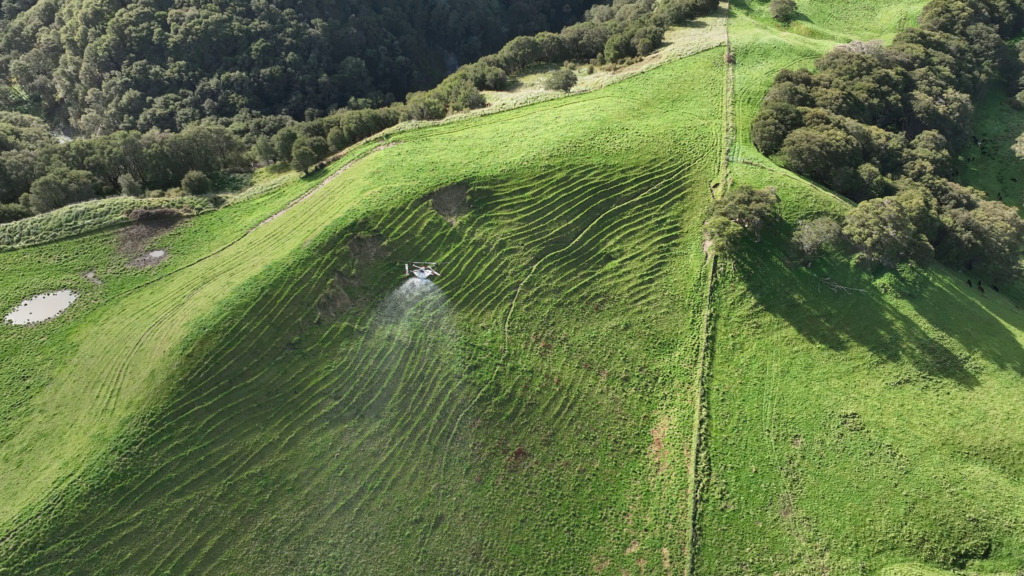
This use case shows how the XAG P150 Max agriculture drone can support fertiliser spreading in steep, broken hill country where accuracy, access and timing all matter. In this real-world application, Airborne Solutions used the XAG P150 Max with its spreading system to apply 17.5 tonnes of fertiliser across 235 ha of effective pasture over two big days.
Background
Airborne Solutions wanted to understand how drone fertiliser spreading would perform in real hill country conditions, not on a flat test paddock, but on a genuine working farm with steep, broken and awkward terrain.
The job took place on a 360-hectare family farm, with roughly 235 hectares of effective pasture once pine blocks, riparian planting, tracks, gullies and other non-productive areas were excluded. The farm’s previous aerial topdressing invoice had come in at $315 per tonne, giving the team a practical benchmark to compare against.
A total of 17.5 tonnes of fertiliser was ordered in one-tonne bags for the job.
The Challenge
Steep, broken hill country creates a specific challenge for aerial spreading. Productive pasture often sits close to pine trees, tracks, waterways and riparian margins, sometimes with only a few hundred metres of usable pasture between non-productive areas.
In this kind of terrain, spreading accuracy becomes extremely important. When fertiliser lands on tracks, trees, waterways or riparian areas, it is product the farmer has paid for, but the pasture never receives the benefit.
Fixed-wing aircraft still play an important role in agricultural spreading, especially for large, open and high-tonnage jobs. However, on broken hill country where product needs to stop and start accurately around awkward boundaries, a drone can offer a different level of control.
The Approach
Airborne Solutions ran the job over two big days using the XAG P150 Max with its spreading system, testing different workflows to understand what actually drives productivity in this kind of terrain.
1. Loading strategy was the productivity driver
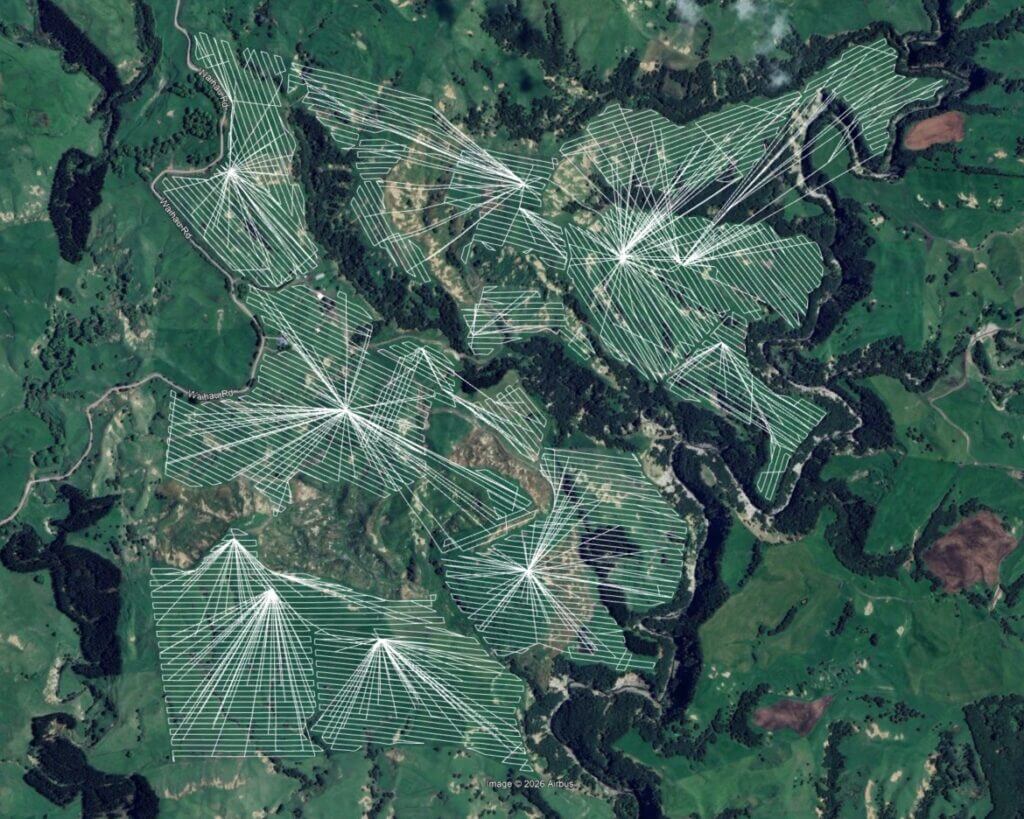
The team repeatedly relocated their loading zone using a tractor and ute, making the most of high points around the farm. This helped reduce unnecessary climbing and travel time, allowing the drone to spend more time spreading and less time working inefficiently across the terrain.
2. 80 kg loads kept the drone productive
For this job, the team ran 80 kg loads and kept the drone moving efficiently. The goal was to use the payload properly, rather than running lots of half-productive trips.
3. Terrain following was switched off for spreading
Unlike spraying work, terrain following was not required for this fertiliser spreading job. Turning it off helped maintain productivity, allowing the drone to work efficiently with full loads across the terrain.
4. One drone, then two
Day one focused on running one drone to establish a realistic productivity baseline. On day two, the team added a second drone. One drone worked closer to the loading zone on more productive nearby runs, while the second handled longer and more awkward runs further away. This two-drone workflow suited a farm with everything from small three-hectare blocks through to larger blocks closer to 40 hectares.
5. Compliance was part of the planning
Because operating from high points across steep terrain can create aviation considerations, the job was completed under Airborne Solutions’ operating manual, with the required NOTAM process completed where needed.
Results
17.5 tonnes applied | 235 ha covered | 2 big days
The standout result was not just coverage. It was accuracy.
Fertiliser was placed right up to pasture edges and stopped cleanly around tracks and pine boundaries. This level of edge control is difficult to achieve with a fixed-wing aircraft operating at speed, especially on broken country with irregular productive areas.
The job also showed how important workflow planning is for drone spreading. High-point loading zones, 80 kg loads and a two-drone setup helped make the operation more efficient across difficult terrain.
Key Benefits
More accurate placement, less wasted product
On broken hill country, accuracy directly affects input value. The XAG P150 Max helped place fertiliser closer to productive pasture and reduce waste on pine trees, tracks, waterways and riparian areas, keeping more product where it could actually benefit the farm.
Better access to difficult blocks
Drone spreading gives farmers and contractors another option for areas where ground access is slow, difficult or limited.
More flexible timing
One of the major advantages of drone spreading is timing. If the conditions are right, fertiliser can be applied when the farm needs it, rather than waiting for aircraft availability.
More productive use of the same drone platform
With the XAG P150 Max, the same drone can be set up for spraying or spreading depending on the job. In conditions where spraying may not be suitable, fertiliser spreading can still be a practical way to keep the platform working and add value across the season.
Lower fuel use for this type of job
Airborne Solutions estimated the job used around 50 litres of petrol across the ute, tractor and charging setup, supported by battery charging. By comparison, a fixed-wing topdressing aircraft can burn several hundred litres of fuel on a job of this type, depending on flight time and conditions.
Cost and ROI Considerations
This use case does not suggest that drone spreading is always cheaper than aircraft on a simple per-tonne contracting rate.
For large, open and high-tonnage jobs, fixed-wing aircraft remain a highly efficient option.
The economics become more interesting on steep, broken hill country, where accuracy, access, timing and reduced fertiliser waste all contribute to the overall return.
For farmers or groups of farms that own the drone equipment, the calculation can shift further. When regular spreading work is available, the value comes not only from the application rate, but from keeping fertiliser on productive areas, improving timing and making better use of the drone across the season.
Key Takeaways
Precision reduces waste.
On broken country, keeping fertiliser off pine trees, tracks, waterways and riparian areas directly reduces the amount of purchased product that delivers no pasture benefit.
Loading logistics matter.
High-point loading zones and fast ground turnaround are key to improving tonnes per hour.
Multi-drone operations can scale effectively.
Matching each drone to different run lengths and block sizes helps improve workflow across awkward terrain.
Timing flexibility has real value.
Drone spreading allows fertiliser to go on when conditions are suitable, with the option to stagger applications across different blocks or farm systems.
Source
This use case is based on the original Airborne Solutions article: “17,500KG With a Drone!”
More Use Cases